It's been getting cooler and the leaves are starting to change colors and fall off the trees. Now that Joe and I are both working, it's more difficult to get homemade meals on the table each night, but we managed to come up with a quick meal that it also appropriate for the dropping temperatures.
For this soup we decided to incorporate the local noodles - Spätzle. Most Americans pronounce this something like spat-zell, but it should actually sound more like spetz-leh. What we did was to saute some chicken, onions and carrots, then add broth and spices until the carrots were mostly cooked. Then we added fresh spätzle (you can also find it dried) and cooked until the noodles were soft. Perfect for a cool fall evening.
Sunday, October 20, 2013
Sunday, October 13, 2013
What do we eat? Part II: Zwiebelkuchen
Yesterday I wrote about how we make some foods here that we are used to having in the States. However, we have incorporated a number of local foods into our diet. It's simply easier, because all of the ingredients are readily available here, and the cuisine is actually not all meat and potatoes.
This time of year (fall) is the time for Zwiebelkuchen (onion cake). Actually, you can find Zwiebelkuchen in bakeries year-round, but traditionally people eat it with new wine (Federweisser or Neuer Wein), that is basically actively fermenting grape juice. You can only get new wine in the fall. Joe and I thought that maybe Zwiebelkuchen was special to this region (Swabia), but it turns out it is eaten all over Germany, with regional differences in how it is made.
We had Zwiebelkuchen last Sunday at our local hiking hut - it was a special once-a-year event. We also went to a Zwiebelkuchen party with some colleagues this weekend. Meantime, I made Zwiebelkuchen at home for Joe and I. Each Zwiebelkuchen had a slightly different character, but I have to admit I was quite pleased with how mine turned out. If you are looking for a new recipe to try this fall (and aren't adverse to massive quantities of onions!), I would recommend it.
Zwiebelkuchen
-Prepare a yeast dough according to the package instructions, or prepare it from scratch like you are going to make a pizza.
-Cut 800 g (yes, 0.8 kg!) of onions into rings. I used onions grown in the village next to us and had to take several breaks due to tears. German onions tend to be quite pungent.
-Saute the onions in a few tablespoons of oil until they are glassy. Remove them from heat to allow them to cool.
-Mix two egg yolks (or two whole eggs if you are lazy like me) and 200 g cream together in a bowl.
-Roll out the dough and spread out the onions. Season with salt, pepper and caraway seeds. (Note: caraway is something that is to me a really typical German flavor - think sauerkraut).
-Sprinkle 250 g shredded gouda and bacon or ham on top of the onions. (Note: I used about 100 g of bacon cubes and this was plenty, although the recipe I roughly followed called for 400 g! If you can't get cubed bacon, I think ham or crumbled bacon would be fine.)
-Now top with the egg/cream mixture and bake for 30-40 min. at 200 C. Enjoy!
This time of year (fall) is the time for Zwiebelkuchen (onion cake). Actually, you can find Zwiebelkuchen in bakeries year-round, but traditionally people eat it with new wine (Federweisser or Neuer Wein), that is basically actively fermenting grape juice. You can only get new wine in the fall. Joe and I thought that maybe Zwiebelkuchen was special to this region (Swabia), but it turns out it is eaten all over Germany, with regional differences in how it is made.
We had Zwiebelkuchen last Sunday at our local hiking hut - it was a special once-a-year event. We also went to a Zwiebelkuchen party with some colleagues this weekend. Meantime, I made Zwiebelkuchen at home for Joe and I. Each Zwiebelkuchen had a slightly different character, but I have to admit I was quite pleased with how mine turned out. If you are looking for a new recipe to try this fall (and aren't adverse to massive quantities of onions!), I would recommend it.
Zwiebelkuchen
-Prepare a yeast dough according to the package instructions, or prepare it from scratch like you are going to make a pizza.
-Cut 800 g (yes, 0.8 kg!) of onions into rings. I used onions grown in the village next to us and had to take several breaks due to tears. German onions tend to be quite pungent.
-Saute the onions in a few tablespoons of oil until they are glassy. Remove them from heat to allow them to cool.
-Mix two egg yolks (or two whole eggs if you are lazy like me) and 200 g cream together in a bowl.
-Roll out the dough and spread out the onions. Season with salt, pepper and caraway seeds. (Note: caraway is something that is to me a really typical German flavor - think sauerkraut).
-Sprinkle 250 g shredded gouda and bacon or ham on top of the onions. (Note: I used about 100 g of bacon cubes and this was plenty, although the recipe I roughly followed called for 400 g! If you can't get cubed bacon, I think ham or crumbled bacon would be fine.)
-Now top with the egg/cream mixture and bake for 30-40 min. at 200 C. Enjoy!
| What 800 g of onions looks like. I cut julienne, btw. Not skilled enough for proper rings. |
| Zwiebelkuchen before the cheese, egg, cream and baking. |
![]() |
| Joe eating Zwiebelkuchen. He does not enjoy onions, bacon and cheese nearly as much as I do. |
Saturday, October 12, 2013
What do we eat? Part I: Pumpkin muffins
In the past we have told you about all the great road-side stands that sell pumpkins on the honor system. That means we eat a lot of pumpkin in the fall. No complaints. However, one pumpkin product we sadly have not found in Germany is canned pumpkin. The logical conclusion from this is that Germany, despite its plethora of delicious baked goods and cakes eaten every day promptly at 3:00 pm with coffee, lacks pumpkin sweets. No pumpkin lattes, pumpkin cookies, pumpkin pie... :(
But fortunately we have connections in the US, and make semi-regular trips there. So I will admit, at the risk of paying back customs, to smuggling cans of Libby's pumpkin into Germany. With the weather feeling determinedly autumnal, I baked pumpkin muffins last weekend with my imported - pureed gold?
The occasion was the 1st birthday our friends' son. He was born on Reunification day (Oct. 3; "Tag der Deutschen Einheit"), the holiday that celebrates East and West Germany being re-united. That means the little guy gets the day off on his birthday every year. And it didn't escape the attention of the nurses when he was born, that his mother grew up in former east Germany, and father in west Germany. That is a bit of poetry.
But back to the muffins. I found the recipe on the Libby's website. I made a few modifications: I used local apple cider instead of orange juice, and sunflower not vegetable oil. I think most Germans are used to muffins made with butter, not oil, which tend to be dryer. Sometimes I find the oil-based muffins to be a bit too moist. I also utilized my smuggled stash of McCormick's pumpkin pie spice.
I topped the muffins with Nutella frosting. Yes, this could certainly be an entry for This is why you're fat. I'm not sure that Germans really appreciate frosting, because I brought the muffins into work unfrosted and put them next to the tub of Nutella frosting. The muffins disappeared but the frosting lingered. Oh well. I do quite like the German version that appears on donuts. It's called "Fettglasur" (fat glaze). How is that for truth in advertising?
If you are in Germany and want to enjoy homemade pumpkin muffins, you will have to do a bit of extra work. You will have to bake and puree the pumpkin yourself. I'm also not sure we can find the classic baking pumpkin used in the US here in Germany. They look like this.
But fortunately we have connections in the US, and make semi-regular trips there. So I will admit, at the risk of paying back customs, to smuggling cans of Libby's pumpkin into Germany. With the weather feeling determinedly autumnal, I baked pumpkin muffins last weekend with my imported - pureed gold?
The occasion was the 1st birthday our friends' son. He was born on Reunification day (Oct. 3; "Tag der Deutschen Einheit"), the holiday that celebrates East and West Germany being re-united. That means the little guy gets the day off on his birthday every year. And it didn't escape the attention of the nurses when he was born, that his mother grew up in former east Germany, and father in west Germany. That is a bit of poetry.
But back to the muffins. I found the recipe on the Libby's website. I made a few modifications: I used local apple cider instead of orange juice, and sunflower not vegetable oil. I think most Germans are used to muffins made with butter, not oil, which tend to be dryer. Sometimes I find the oil-based muffins to be a bit too moist. I also utilized my smuggled stash of McCormick's pumpkin pie spice.
I topped the muffins with Nutella frosting. Yes, this could certainly be an entry for This is why you're fat. I'm not sure that Germans really appreciate frosting, because I brought the muffins into work unfrosted and put them next to the tub of Nutella frosting. The muffins disappeared but the frosting lingered. Oh well. I do quite like the German version that appears on donuts. It's called "Fettglasur" (fat glaze). How is that for truth in advertising?
If you are in Germany and want to enjoy homemade pumpkin muffins, you will have to do a bit of extra work. You will have to bake and puree the pumpkin yourself. I'm also not sure we can find the classic baking pumpkin used in the US here in Germany. They look like this.
| Pumpkin muffins - minus the Nutella frosting. |
Saturday, September 14, 2013
Fun in the Alps
In August, Joe and I rented a car and drove to Bavaria to go hiking in the alps for the weekend. It is something we've been talking about doing since we moved here and left all of Colorado's beautiful mountains behind, but just hadn't managed it yet. We played hooky with a Friday afternoon and drove the backroads through the Swabian Alb to Bavaria, along the way encountering the Zwiefalten Abbey. The church is a beautifully preserved example of German Baroque, and a good example of why we like living here: the luxury of exploring the region and finding places off of the main tourist itinerary.
We stayed two nights at the University's mountain cabin near the border with Austria. We've reported about our stays here in the past, but always in the winter. For some reason I wasn't expecting much because I love it there in winter so much, but the mountains are breathtaking in summer (literally!).
We spent an entire day hiking, probably 15-20 km, and summitted three different peaks. It's a very different experience of hiking somewhere like Colorado, with far fewer people especially as you go further away from the front range. In the Alps we can also stop for lunch at a mountain hut, only really an option at designated ski areas in the western US. But one thing is the same: cows. Fortunately we knew to expect them for a few km because they really do wear cowbells! In fact, every "herd" has a bell with a slightly different sound.
We summitted a few more (lower) peaks the next morning before hopping in the car. On the way home we got stuck in traffic on the Autobahn so again diverted to the backroads. It was a good chance to see another local attraction that has been on our list: the Blautopf ("blue pot") in Blaubeuren. It is a karst-fed spring with a beautiful blue color.
We stayed two nights at the University's mountain cabin near the border with Austria. We've reported about our stays here in the past, but always in the winter. For some reason I wasn't expecting much because I love it there in winter so much, but the mountains are breathtaking in summer (literally!).
We spent an entire day hiking, probably 15-20 km, and summitted three different peaks. It's a very different experience of hiking somewhere like Colorado, with far fewer people especially as you go further away from the front range. In the Alps we can also stop for lunch at a mountain hut, only really an option at designated ski areas in the western US. But one thing is the same: cows. Fortunately we knew to expect them for a few km because they really do wear cowbells! In fact, every "herd" has a bell with a slightly different sound.
We summitted a few more (lower) peaks the next morning before hopping in the car. On the way home we got stuck in traffic on the Autobahn so again diverted to the backroads. It was a good chance to see another local attraction that has been on our list: the Blautopf ("blue pot") in Blaubeuren. It is a karst-fed spring with a beautiful blue color.
Tuesday, September 10, 2013
Italy
This year my main professional conference took place in Florence, Italy. So, Joe and I headed there a few days earlier. It was our first trip to Italy. We spent our first day touring town, and saw the Cathedral ("Duomo") designed by Brunelleschi. All of that colorful marble is sure a difference from the austere sandstone or limestone facades in Germany (and German churches are actually quite vibrant in comparison to those we saw in Benelux).
Then we spent two days hiking an amazing stretch of coastline called the Cinque Terra. It's a national park, notoriously crowded and it was August, when all of Europe was on vacation. We went anyway and had a great time. There were tons of trails to get lost on. All roads led to the town of Vernazza (for us, at least), which I thought was quite well situated. So I am posting pictures of it from all angles. We swam at the little beach on the left side of town, looking seaward. We hiked about 35 km in the two days, so really covered the coastline from one end to another.
We returned to Florence and went to the famous galleries, where we saw a lot of art. Joe flew back home and I went to my conference. I don't have any pictures of that. I had an extra day at the end of the week after the conference and before my flight back, so I took a bike ride through Tuscany with a colleague. We stopped at what is apparently one of the oldest wineries in Italy. Delicious! We ended our ride in Siena, which is a gorgeous town with a beautiful cathedral. Not to mention the mummified face of Saint Catherine of Siena. I love that gory stuff!
Then we spent two days hiking an amazing stretch of coastline called the Cinque Terra. It's a national park, notoriously crowded and it was August, when all of Europe was on vacation. We went anyway and had a great time. There were tons of trails to get lost on. All roads led to the town of Vernazza (for us, at least), which I thought was quite well situated. So I am posting pictures of it from all angles. We swam at the little beach on the left side of town, looking seaward. We hiked about 35 km in the two days, so really covered the coastline from one end to another.
We returned to Florence and went to the famous galleries, where we saw a lot of art. Joe flew back home and I went to my conference. I don't have any pictures of that. I had an extra day at the end of the week after the conference and before my flight back, so I took a bike ride through Tuscany with a colleague. We stopped at what is apparently one of the oldest wineries in Italy. Delicious! We ended our ride in Siena, which is a gorgeous town with a beautiful cathedral. Not to mention the mummified face of Saint Catherine of Siena. I love that gory stuff!
Monday, September 9, 2013
Chronicles of the Low Countries, or Benelux, Beer and Bikes?
We just returned last night from our big summer trip(s) and are hopelessly behind on posts. So I will start with a recap of our most recent trip, then see if I am ambitious enough to work through the summer backlog.
My friend from college (and bridesmaid) Liz and her boyfriend Pete are visiting us from Vermont. We rented a car and drove up to The Netherlands and Belgium for a week. We entered the The Netherlands from the triple junction with Belgium and Germany, which coincidentally is the high point (vertically) of the whole country.
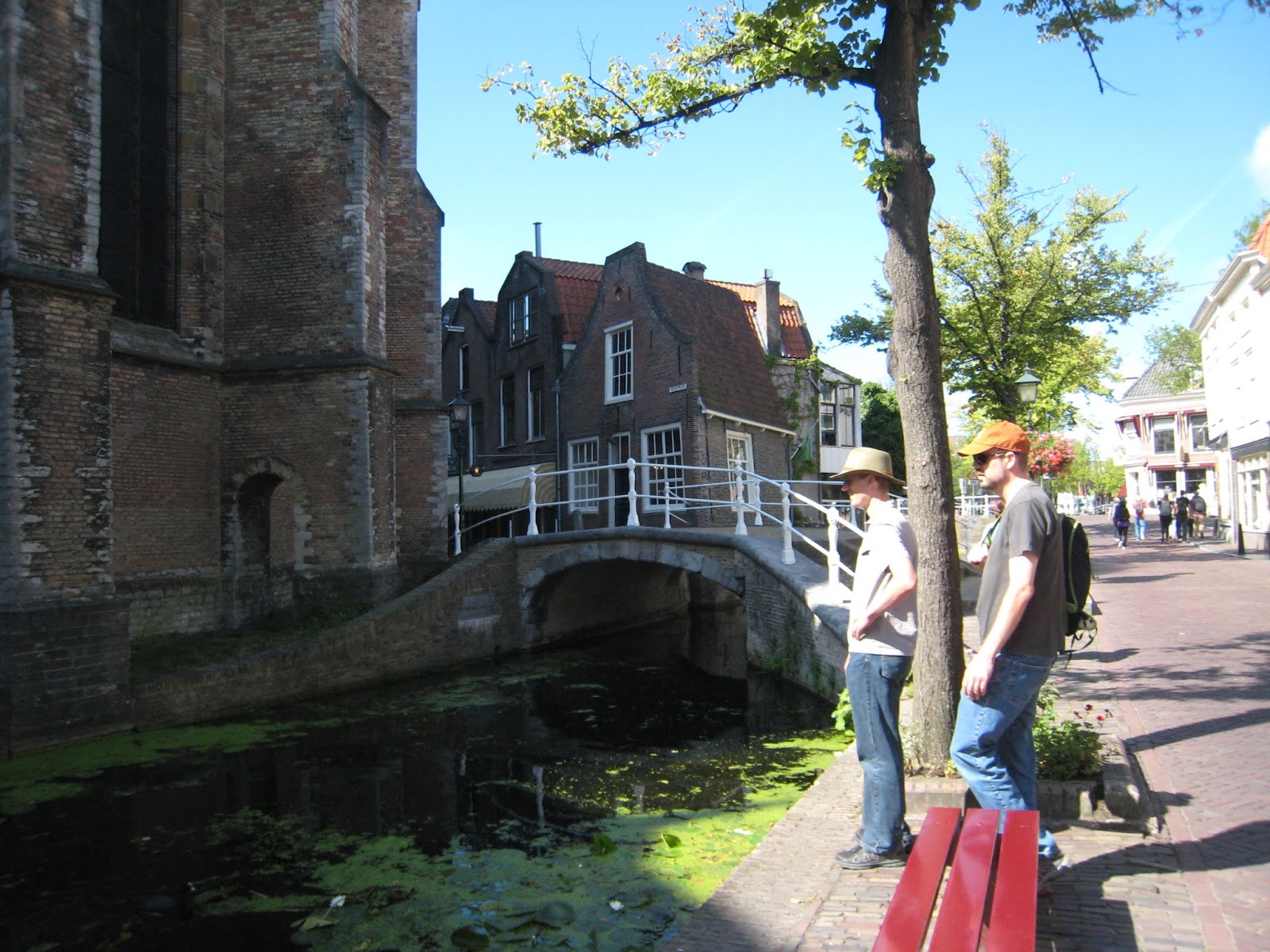
We had a wonderful first day in the town of Delft. It is true that Dutch people are friendly and nice. We took a walking tour of the city's canals, and learned the history of its churches, famous painters (Vermeer) and its iconic blue and white pottery. We also had a canal boat tour and ate fried fish and mussels. Joe was brave enough to try the local specialty: pickled herring sandwich.
We stayed at a beach house in the Netherlands, which we jokingly called the retirement home. But it had a thatched roof and was close to some awesome beaches. We had a picnic one night, drinking Belgium beer as the tide went out and the sun went down.
It turns out that the Netherlands and northern Belgium have some commonalities: people speak Dutch and their towns have a lot of canals. We stopped in Ghent for lunch and Brugges overnight. Don't let Rick Steves tell you that Brugges is overrun with tourists and not worth a visit - we loved it!
After all our time in the lowlands, we had really worked
up a thirst. So we headed south toward the border with France to find
some breweries and abbeys. We saw a local hops festival advertised, so
we spent some time drinking the family's microbrew and got to experience
our first hops-picking contest.
My friend from college (and bridesmaid) Liz and her boyfriend Pete are visiting us from Vermont. We rented a car and drove up to The Netherlands and Belgium for a week. We entered the The Netherlands from the triple junction with Belgium and Germany, which coincidentally is the high point (vertically) of the whole country.
| Highest point in the Netherlands: 327.5m. |
![]() |
| Old city gate in Delft |
| Beach, beer and 1 MW installations on a North Sea dike. |
| Joe contemplates what the tide left behind. |
| Canal in Ghent. |
| Canal in Brugges. |
Afterward we stumbled through Thuines, which although off the beaten path, was worth a visit. We got to climb up the bell tower and hear the bells rung and carillon played. I took a short video of the carillon because it was amazing. The town is backed up by terraced paths separating private gardens and vineyards, where we goofed around for awhile.
We ended our tour of Belgium with a visit the Abbaye D'Aulne, which was destroyed in the 18th century. I always find it amazing that something in such disrepair can be so beautiful. If you're a photographer, put it on your travel list!
Our trip was so full that in the end we did not ride bikes, but I certainly did covet a number of cute single speed Dutch bikes. Alas, not practical for where we live. We did, however, come home with a trunk full of Belgium beer!
|
Sunday, August 4, 2013
Eau de Cologne
In early July I went to Cologne (Köln) for a work trip. Joe
was supposed to join me, but had to make an emergency trip to Alaska. So, I was
left to explore the city on my own, and with help of Sebastian, my brother's friend who is from the region.
Cologne is famous for 5 things, in my estimation, listed in
the order I experienced them: beer, the Cathedral, cologne, Karneval, and being a major
Roman settlement.
| Kölsch coaster |
As part of my work meeting we went out to a brewery for
dinner. The beer that is famous in Cologne is Kolch, a rather light beer served
in 0.2-0.3 L portions (small by German standards). Servers carry special
baskets of beer, and when yours is empty you automatically get another and a
mark on your coaster indicating how many you have received. My solution to stop
this process was to not finish my last beer. In fact, the appropriate action is
covering your glass with the coaster.
| View of Cathedral spires. |
After my meeting, I met with Sebastian and we climbed to the
top of the Cathedral (“Dom”). We timed our visit perfectly, because we were in
the belfry for the noon ringing. The views of town and the Rhein were great –
although it looked a bit different from the style of wood-beam building I am used to in
the south. We later went on a tour and learned that it took 800 years to
complete the cathedral, which is evident from the different types of stone used
at different stages. The cathedral houses relics of the three wise men, which
has made it am important pilgrimage site. The cathedral was thronged with
tourists when we visited; but only twice as many per day as visited in the Middle Ages.
Cologne (the fragrance) takes its name from the city, and there are two
companies that claim to have pioneered the first cologne recipe (still used
today, of course). Both occupy prominent buildings in the city’s center, and
generally seem to be oblivious to the other’s presence. Well, whatever the
technical definition of cologne is and who made it first, I’m pretty sure
Cleopatra used something to make her smell nice millennia earlier.
| Party on the riverfront |
Cologne is probably the biggest party scene in Germany during Karneval season. You've seen the pictures of parades for the equivalent "Fasnet" in our region, but apparently Cologne celebrates on a much larger scale. Although it was not Karneval season, I did experience the city's party personality through the "Kölner Lichter", the summer fireworks festival. The riverfront was thronged with people and boats enjoying bands, food and beer, and awaiting an evening fireworks display.
The day I left I visited the Roman museum in the city. During building projects over the centuries, a lot of finds have been made beneath the current city. Some of the grandest include tile mosaics. Apparently one hosted a dinner of international leaders, including President Clinton. I still can't believe even world leaders were allowed to walk on it. There was a lot of other interesting stuff in the museum, but I really liked the pitcher and cup sets, complete with an inscription that said something like, "to your health!" I could imagine something similar for sale at World Market - so I guess we haven't changed so much from Roman times.
| Roman wine service. |
Subscribe to:
Posts (Atom)