Saturday, March 1, 2014

Iran to Turkey because I was Hungary

Joe and I have tried to make the most of living in Europe in terms of opportunities to travel to new places. Over Christmas and New Year we took a 2-week trip to Aegean coast of Turkey, which included a 1-week German language bus trip and one week at a seaside hotel. We plan on going back to Istanbul at some point. It's taken us awhile to get a post up, but here are some highlights of our first week.

Pamukkale and Heiropolis

I was really looking forward to the travertine deposits, but I had no idea an ancient city was built on top of them. You got nothin', Mammoth Hot Springs! Heirapolis was inhabited from the 2nd century BC to the 14th century AD. There is an extensive cemetery as the hot springs were thought to have healing powers, so lots of sick rich people came, and died. The structures in Turkey are fairly well preserved, as they used good building material for the arid climate(limestone, marble, travertine); the earthquakes have certainly taken their toll.


Bodrum

We spent Christmas in the resort town of Bodrum. It is pretty posh by Turkish standards, and building code requires that all structures are painted white. It just so happens this looks stunning against the Mediterranean backdrop. Bodrum is also the site of the world's first Mausoleum, the resting place of King Mausolus, with construction directed by his widow. It seems the concept of a mausoleum took off after that. Paul, of Bible fame, also came through what was then Halicarnassus (now Bodrum) on his travels. And, the city was conquered by Alexander the Great in 334 BC.

A mean, old wave attacks Joe.
Remains of the mausoleum.


Tombs near Demre, Turkey

Looking back on it now, much of the ancient structures we saw in Turkey were monuments to the dead. These tombs carved into the wall along a river in Demre were definitely the most unique. We took a boat tour to see them, and ended up on a small sand island where the river meets the sea. Our lunch that day was freshly caught crab.

Our seaworthy vessel.
Juxtaposition of ancient and modern burial practices.
Fisherman

The Sunken City at Kas

Our next stop was an ancient city that sunk following an earthquake, so the remains are under a few feet of turquoise water a boat ride away from town. Gosh, it would have been nice to see that, but it wasn't included in our tour, and our guide was always a bit sketchy and underhanded about the "extra side-trips" he was offering. So we stayed on shore and explored some un-sunken ruins. More tombs, it seems.

Church of St. Nicholas in Demre

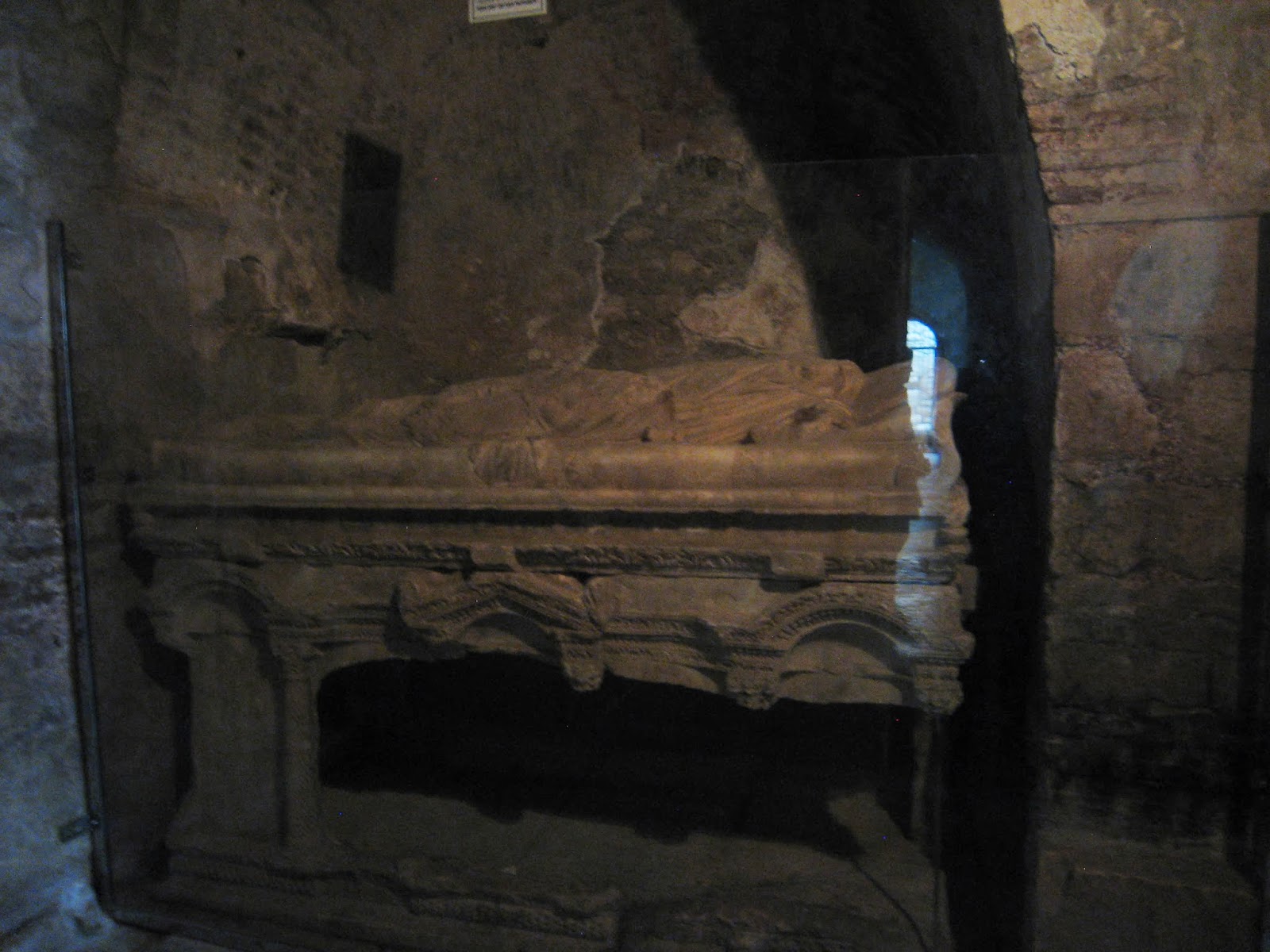
Also in Demre, we visited St. Nicholas' church in the city formerly known as Myra. The church is in ruins, but retains the tomb of St. Nicholas, as well as some beautiful artwork. Some of the artwork depicted a Roman times when Christians met in hiding. Father Christmas seems to be pretty popular with Russians, as we saw a lot of Cyrillic.

Pere Noel's tomb.
Antalya

The final day of our bus tour was spent in Antalya, which is known primarily as the gateway to the Turkish Riviera, but actually has quite a nice old city. We went on a cheesy pirate ship tour of the harbor, and tried goat's milk ice cream. Then we had some time for shopping in the bazaar and witnessed a protest.

This guy used his long stick to whip the cone out of your hand just as you grabbed it. Getting ice cream meant "enduring" his performance, but it was fun.
Protests against President Erdogan in Antalya, Turkey.


Monday, November 11, 2013

Sankt Martins Tag (Elfte Elfte)

The eleventh of November is St. Martin's Day in Germany. It is now our third November in Germany, and I was determined to finally experience this traditional event. The only problem is that it is mostly for children. So I had to convince my work colleague Caroline and her 1-year old son to join me.

St. Martin's day is a Catholic holiday celebrating a saint who gave have his cloak to a poor man during a snowstorm. We went to the local church and saw a re-enactment of this saintly event by men dressed as Roman soldiers. This part was fun, but then there was some religious message and kids were getting antsy and louder by the minute. Then, we went outside, and Roman soldier St. Martin on his horse led us around the neighborhood. We were accompanied by a brass band and we periodically stopped to sing:

"Laterne, Laterne, Sonne, Mond und Sterne..."

Because the most important part of St. Martin's day are the lanterns!

So before we went out, Caroline and I improvised some lanterns. Mine was a giant pickle jar with golden leaves glued onto it. Unfortunately the little guy pulled off the biggest leaf, and so at some point it became just a giant pickle jar with a tea candle inside.

All of the children make their lanterns in school, and some are quite elaborate. However, I think if we put more than 20 minutes effort in next time, we could really show those kids up, because Caroline's partner is an art teacher. The festivities ended with Kinderpunsch and Bretzeln back at the church.


Sunday, November 3, 2013

Freewheelin' in Freiburg

Over the summer, Joe got back to his roots of doing ridiculous feats of endurance. A two-time Ironman, he has not been involved in any kind of formal race since we've been living in Germany, but he did go on several all-day bike rides this summer. And by all day, I mean all day. Most of these were 200-300 km in a single stretch. Once he rode to Munich, while our friend Rachel and I left mid-morning by train and met him for dinner. Another trip took him to Mannheim, then home by train late that night. He is famous to my colleagues for having biked to Strasbourg, on the border with France, and back, up and over the Black Forest, all in a single day. One weekend this summer he decided to ride to Freiburg, in the southwestern corner of Germany, which is also the sunniest part of Germany. Because the Black Forest stand between our house and Freiburg, it took me almost as long to get there riding the trains as it did for him. So we meet for a late lunch and enjoyed a sunny afternoon in Freiburg. Joe rode his bike back the next day, and I again rode the train.

We quite enjoyed the town of Freiburg. It is a university town, so has an openness and youthful energy about it. The town was quite wealthy and was able to buy its independence in the middle ages, hence its name. A unique feature of the town are the small canals that divert river water through the town center. These were perfect to dip your feet in on a hot summer day. We also hiked up for a view over the valley, surrounded by forest. And of course, we stopped in a local beer garden for some refreshment.


City canals a perfect for hot summer days.
Taking advantage of the city's water supply on a short hike.
View of the Freiburg valley.
Freiburg Cathedral. The sandstone reminded me of Mount Holyoke.

What do we eat? Part IV: Flammkuchen

We live fairly close to the Alsace region on the border between France and Germany. The culinary influences pervade into our region, most famously with "Flammkuchen", a sort of thin-crust, white sauce pizza. It is widely available in restaurants here, but lately I've enjoyed making it at home. This makes for a quick and easy meal because I can buy the dough and skip the most time-consuming step. Flammkuchen is cooked in a very hot oven, and the sauce is made from creme fraiche, although sour cream could substitute. Traditionally, the toppings are bacon and onions. I've also enjoyed experimenting with adding feta cheese and sauteed pumpkin. I found a recipe online in case I've piqued your appetite!


Tuesday, October 29, 2013

The Stuttgart Wine Trail

This last weekend was peak fall colors in our area, so we decided to take a hike with friends like we did last year at this time. We chose the Stuttgart Wine Trail, which traverses a large hill surrounded by scenic villages, where wine is likely the main industry. However, it is just a stone's throw from Stuttgart. The wine trail itself is probably a scheme to bring in tourists, but it worked and we had a beautiful day for it. Admittedly, we tried a bit of the produce as we wandered along the trail, but we did end our adventure at a local wine "Besen" where we paid for the goods.


Sunday, October 20, 2013

The Danube Prequel

Like many sagas, sometime the beginning happens after the fact. That is exactly how we are treating the nearly 700 km bike ride we did along the Danube last April. We started our spring ride in Ulm, about 170 km downstream from the source of the river in Donaueschingen (the Danube is called "Donau" in German). So over the summer, we convinced our friends Barb and Adam (Americans; Barb is also a postdoc in our institute) to ride the first 80 km with us one weekend.

We headed off by train one Saturday morning in July. The Deutsche Bahn (German rail company) makes it pretty easy to purchase a one-day pass for a group, with bikes even, to ride the local trains. We arrived in Donaueschingen around 11 am and our first order of business was the find the mythical source ("Quelle") of the river. Unfortunately it was under construction! So we only saw it from a distance. We were however somewhat appeased by finding the distribution center for Fürstenberg beer on our winding route out of town.


Unfortunately our ride coincided with one of the summer's hottest weekends. We compensated for the kilometers of sunny, hot riding by making several stops to cool off. At one stop we found some small holes in the ground connected to what was probably underground limestone caves. They were releasing cool air - a sort of natural air conditioning. The four of us huddled around one of these caves for probably far too long. We also went swimming in the river, and once at a Freibad (public outdoor swimming pool) in one of the towns along the river. And of course, we drank plenty of Radler (shandy, or lemonade mixed with beer) that is the drink of bikers.


There were a few interesting sights to see along our ride. One was the Donauversickerung (the Danube percolation). In a few spots along this stretch of river, the water percolates down through slanted layers of rocks and ends up in tributaries of the Rhine. During some times of the year, almost all of the water disappears over short stretches of river. How is that for a clever way to steal water? We stopped at one of these points to see the river disappearing, and even saw/heard a few spots where water was being sucked down. I especially like the descriptions of radioisotope experiments (51Cr) done nearly a hundred years ago to figure out how long water took to travel to the Rhine (about 1 hour/km). It would be hard to get a permit for such an experiment these days.


We overnighted in the town of Mühlheim an der Donau. It had a terribly cute old town. We were there on Saturday night, in time for the free city tour from the town's only remaining Nachtwächter (night guard). He took us around the old town as the sun set and explained the history, punctuated by singing verses of the Nachtwächter song. The guard watched for fires during the night in medieval times.


So now all that remains of the Danube for us to ride are the 90 km from Sigmaringen to Ulm... and from the Austrian border with Slovakia to the Black Sea. The lower part goes through Slovakia, Hungary, Serbia and Bulgaria (actually I am not totally sure which countries it goes through!), and are not as frequently traveled by bicycle. We will see if we take on that challenge!